



Construction Photo Evidence: How Site Documentation Wins Disputes and Insurance Claims (2026 Guide)

Construction Photo Evidence: How Site Documentation Wins Disputes and Insurance Claims (2026 Guide)
Short answer: A construction photo only counts as evidence if you can prove three things — what it shows, when and where it was taken, and that it hasn't been altered since. In practice, that means capturing images with embedded timestamp and GPS metadata, storing them in a system that preserves an unbroken chain of custody, and being able to produce the original file (not a screenshot) on request. Phones and consumer apps can do part of this. Most fall short on the chain-of-custody piece, which is where claims and cases get lost.
This guide explains what "defensible" actually means for jobsite photos, what insurers and courts look for in 2026, and the documentation habits that protect you when a project goes sideways.
Why this matters more than it used to
Construction disputes are getting bigger and slower to resolve. The Arcadis 15th Annual Global Construction Disputes Report (2025) found that the average value of disputes in North America has risen 43% since 2021, and HKA's CRUX research has consistently shown that disputed sums tend to run around a third of total project capex — with contractors typically pushing for schedule extensions of more than half the original duration.
The most-cited dispute causes haven't changed: errors and omissions in contract documents, failure to understand contract obligations, and owner-directed changes. What has changed is how often the deciding factor in those disputes is the quality of the documentation each side can produce.
If your photo trail is incomplete, ambiguous, or technically challengeable, you can be right on the merits and still lose the money.
What makes a construction photo "defensible"?
Defensible photo evidence is an image that a court, arbitrator, or insurance adjuster will accept as an accurate, untampered record of a specific scene at a specific place and time. Three pillars: authenticity, integrity, and chain of custody.
Each pillar maps to a concrete technical requirement:
- Authenticity — proof the photo shows what you claim it shows. Established through witness testimony ("I took this photo on the south face of the wall at 14:00 on 12 March") and embedded metadata that corroborates it.
- Integrity — proof the file hasn't been modified since capture. Established through original-file preservation and ideally a cryptographic hash captured at the moment the photo was taken.
- Chain of custody — an auditable record of every system, person, and process that touched the file from camera to courtroom. Gaps in this chain are the single most common reason photos get excluded.
Original camera files inherently carry the data needed for the first two pillars: timestamps, GPS coordinates, device identifiers, and other EXIF fields. The catch is that EXIF data can be edited with free tools and device clocks can be manually changed, which is why the chain-of-custody piece — independent corroboration that a file existed in its current form at a given moment — is what separates "a photo on someone's phone" from "evidence."
The four metadata fields every jobsite photo needs
If a photo is missing any of these, expect it to be challenged:
- Timestamp (ISO 8601 with timezone). A date written on a paper log can be reverse-engineered. An EXIF timestamp written by the device's clock at the moment of capture is far harder to dispute — if the clock was correct and the file is the original.
- GPS coordinates. GPS-tagged images give insurers and adjusters irrefutable proof of location and remove "he-said-she-said" arguments about which property, which floor, which jobsite.
- Device identifier. The model and serial of the capturing device anchors the file to a specific source, which matters when multiple subcontractors are documenting the same area.
- Author / capturer. Who took the photo. If the answer is "someone on the crew," the evidence is weaker than "John Doe, foreman, logged in to the site app at 14:02."
A photo with all four, stored on a system that preserves the original file and logs every access, is dramatically harder to dispute than one without.
Where most construction crews lose evidentiary value
Common, costly mistakes:
- Sending photos through WhatsApp or SMS. Most messaging apps strip or recompress EXIF metadata. The recipient gets a JPEG without the timestamp or GPS data that made it useful.
- Screenshots instead of original files. A screenshot of a photo is a new file, with new metadata, that does not preserve the original capture data. Courts increasingly treat screenshots as a separate, weaker evidence class.
- Storing photos only in personal phones. When the foreman leaves, the evidence leaves. There is no chain of custody if the only copy was on a device the company no longer controls.
- No backup at the moment of capture. If a photo was first uploaded three days after capture, you've created a three-day gap an opposing expert will probe.
- Inconsistent file naming. "IMG_4823.jpg" tells you nothing. "2026-03-12_1402_south-wall_crack.jpg" tells the story before anyone opens the file.
- Missing context shots. A close-up of a crack without a wide shot establishing where the crack is, on which wall, in which building, in which project, can be argued to be from anywhere.
What insurers actually want
Insurance adjusters in 2026 are evaluating claims faster — and rejecting faster — when photo documentation doesn't meet a baseline. From multiple insurer guidance documents and underwriter checklists, the recurring asks are:
- Pre-existing condition photos of the site or affected area, dated before the work started or before the loss event.
- Time-stamped progression photos at major milestones.
- Damage / incident photos captured within hours of the event, with multiple angles and a wide-to-tight sequence.
- A coverage map. Photos plotted on a site map so the adjuster can see what was documented and what wasn't. Coverage gaps invite scrutiny.
- Original files, not exports. If the adjuster asks for the original and you can only send a copy, the claim slows down.
Claims with this baseline tend to clear faster. Claims without it tend to get a partial settlement or a denial — not because the work wasn't done, but because the work can't be proven.
The 2026 standard: from "we have photos" to "we have evidence"
The shift happening across the construction industry mirrors what already happened in fields like incident response and forensics: the goalposts moved from capture to capture + custody.
A 2026-grade documentation workflow looks like this:
- Capture in an app that writes EXIF metadata and uploads in real time.
- Seal the file at the moment of capture — cryptographic hashing or qualified timestamping (under frameworks like the EU's eIDAS regulation) prevents later challenges to integrity.
- Tag the photo to a project, location, and report so the context is recoverable months later.
- Store in a system that logs every view, download, and edit — that log is your chain of custody.
- Export when required as the original file plus a custody report, not as a re-saved image.
Crews that operate this way don't just win disputes more often; they tend to avoid disputes, because the other side can see early that the documentation will hold.
A defensible-photo checklist for foremen
Print this. Tape it to the trailer wall.
- App is logged in to the right user before the day starts
- Phone clock is set to network time, not manual
- GPS is enabled and accurate (test with a known location)
- Wide shot first, then medium, then close-up — every time
- Reference object in close-ups (ruler, gloved hand, marked card)
- Photo tagged to the correct project and location at capture
- Caption written the same day, while context is fresh
- Originals never deleted from the system, even if duplicates exist
- Weekly: review coverage map, fill the gaps before the week closes
FAQ
Are smartphone photos admissible in court?Yes — courts accept smartphone photos as evidence, provided you can authenticate them and establish chain of custody. The phone itself isn't the issue; the issue is what happens to the file between capture and courtroom.
Can EXIF data be faked?Yes. Free tools can edit EXIF timestamps, GPS coordinates, and device identifiers. This is why qualified timestamps and immutable storage matter — they create independent corroboration that a file existed in its current form at a given moment.
Is WhatsApp acceptable for construction documentation?Not for evidentiary purposes. Most messaging apps recompress images and strip metadata, which destroys the evidentiary value of the original capture. Use it for casual coordination, not for the photo-of-record.
How long should we keep jobsite photos?Match the longest applicable statute. In most jurisdictions, latent-defect claims can be brought 10+ years after substantial completion. Plan storage and retrieval for at least that long.
Do drone or 360° photos count?Yes, and they're increasingly common for milestone documentation. Same rules apply: original file, embedded metadata, chain of custody, and a coverage record showing what was scanned and what wasn't.
The takeaway
Photos are the cheapest, most powerful evidence on a construction project — but only if the underlying workflow treats them as evidence from the moment of capture, not as memories you might dig up later if something goes wrong. The crews and contractors who win disputes in 2026 aren't the ones who take more photos. They're the ones whose photos survive challenge.
If you're rethinking how your team documents the site, start with the four-metadata rule and the foreman checklist above. Then look at where your photos actually live — because if the answer is "spread across crew members' phones and a few WhatsApp threads," your documentation isn't evidence yet. It's just memory.
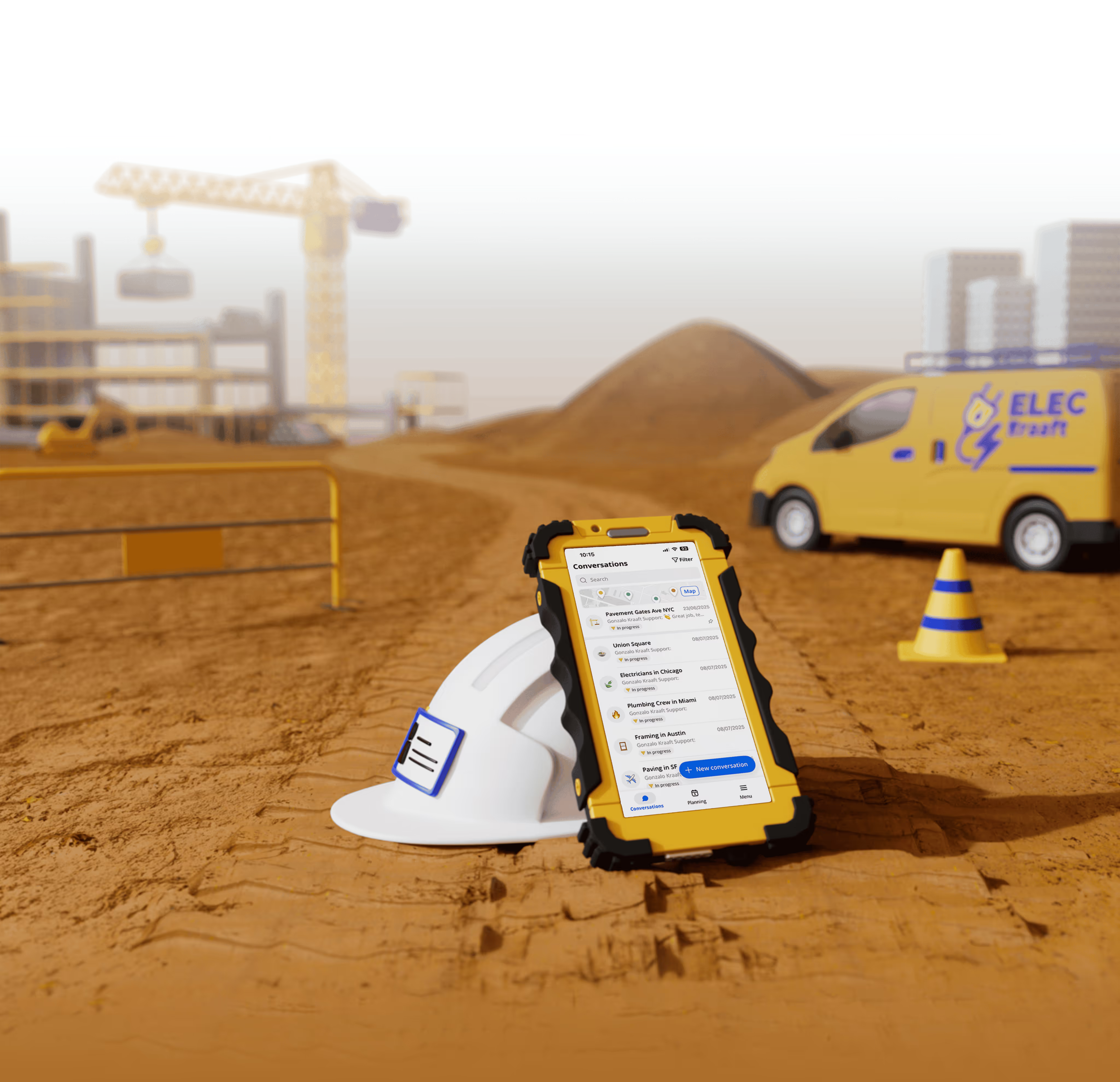
Kraaft is the field-first construction app used by subcontractors and trades to capture timestamped, geotagged photos in real time, organized by project and report. See how Kraaft handles jobsite documentation →

Reconnect the site
and the office