



Construction Site Security: The Complete Guide for HSE Professionals (2026)

Construction Site Security: The Complete Guide for HSE Professionals
Construction sites are among the most vulnerable workplaces when it comes to security. Open perimeters, rotating crews, high-value equipment, and constant movement of people and materials create the perfect conditions for theft, unauthorized access, and serious safety incidents. For HSE professionals, managing construction site security isn't just about protecting assets — it's a core part of keeping workers safe and operations compliant.
This guide covers everything you need to know: the biggest threats on a modern job site, how to build a solid security plan, and how to manage and report incidents effectively.
Why Construction Site Security Is an HSE Priority
Security and safety are often treated as separate disciplines, but on a construction site they're deeply intertwined. An unsecured site is a dangerous site.
When unauthorized individuals access a job site — whether curious passersby, trespassers, or thieves — they expose themselves to real physical hazards: open excavations, scaffolding, unguarded machinery, and hazardous materials. Any resulting injury creates liability for the contractor and the HSE team. Beyond injury risk, security failures drive up project costs, disrupt schedules, and put your team's wellbeing at risk.
According to industry estimates, equipment theft alone costs the construction sector over $1 billion annually in the US, with recovery rates below 25%. In Europe and the UK, similar patterns hold — with power tools, copper wiring, and heavy machinery among the most frequently stolen items. The financial hit is compounded by project delays, insurance claims, and the administrative burden of reporting.
For HSE officers, the message is clear: construction site security deserves the same structured approach as any other safety discipline.
The Top Security Threats on a Construction Site
Before you can build a security plan, you need to understand what you're protecting against. The most common threats HSE teams face on site are:
Theft and vandalism are the most frequent and costly issues. Equipment, tools, materials (especially copper, steel, and cables), and fuel are prime targets. Vandalism — whether opportunistic or targeted — causes direct damage and can create dangerous conditions for workers arriving the next morning.
Unauthorized access puts non-workers at risk and creates liability. This includes trespassers, former employees, unauthorized subcontractors, and even members of the public who wander onto an unfenced or poorly marked site.
Workplace violence and conflict can occur on busy, high-pressure sites where crews from multiple contractors work in close proximity. Security measures that include clear identification and access control help prevent confrontations from escalating.
Data and document theft is an increasingly relevant threat on larger projects. Site offices often contain sensitive contracts, plans, and personnel data. Physical document security and access-controlled site offices are basic but overlooked protections.
Night-time incidents are disproportionately common. Most construction site thefts and break-ins happen outside working hours, when the site is unoccupied and lighting is minimal.
Building a Construction Site Security Plan
A construction site security plan doesn't need to be complicated, but it does need to be documented, communicated to all relevant parties, and regularly reviewed. Here are the core components every HSE professional should address.
1. Perimeter Control and Access Management
The first line of defense is physical. A properly secured perimeter — hoarding, fencing, locked gates — controls who can enter and when. Complement this with a clear access control system: every person on site should be identifiable, registered, and authorized to be there. Visitor logs, contractor sign-in sheets, and badge or pass systems all contribute to this.
Define clear entry and exit points. Multiple informal access routes are one of the most common security gaps on active sites.
2. Site Lighting
Poor lighting is an invitation for unauthorized access and theft. Ensure all perimeter areas, storage zones, and high-value equipment areas have adequate lighting outside working hours. Motion-activated lighting is a cost-effective deterrent.
3. Equipment and Material Security
Document all assets on site with serial numbers, photographs, and location records. Store high-value equipment in locked compounds when not in use. Mark tools and machinery visibly — marked items are significantly harder to sell and easier to recover. Consider GPS tracking for plant and heavy machinery.
4. CCTV and Remote Monitoring
Surveillance cameras are now a standard part of construction site security, but placement matters. Prioritize entry points, storage areas, and any area where high-value work is happening. Remote monitoring — where a security provider watches live feeds outside working hours — significantly improves response times to incidents.
5. Security Personnel
For larger or higher-risk sites, manned guarding remains one of the most effective deterrents. Guards can perform patrols, check credentials, respond to alarms, and provide a visible presence that passive systems cannot replicate.
6. Subcontractor and Visitor Management
Security weaknesses often arise at the interfaces between contractors. Establish a clear protocol: every subcontractor on site should have been vetted, have a designated point of contact, and know the site's security rules. Visitors — clients, inspectors, delivery drivers — should be escorted or supervised.
Security Incident Reporting: Getting It Right
Even on a well-secured site, incidents happen. How quickly and accurately you report them makes a significant difference to the investigation, insurance claim, and prevention of future events.
A good security incident report should capture: the date, time, and location of the incident; who discovered it and how; a factual description of what happened; any evidence (photos, CCTV timestamps, witness statements); immediate actions taken; and any estimated losses or damage.
The quality of your incident reports directly affects the outcome of insurance claims and legal proceedings. Vague, delayed, or incomplete reports create disputes. Timely, photo-supported reports with GPS-stamped locations give you a defensible record.
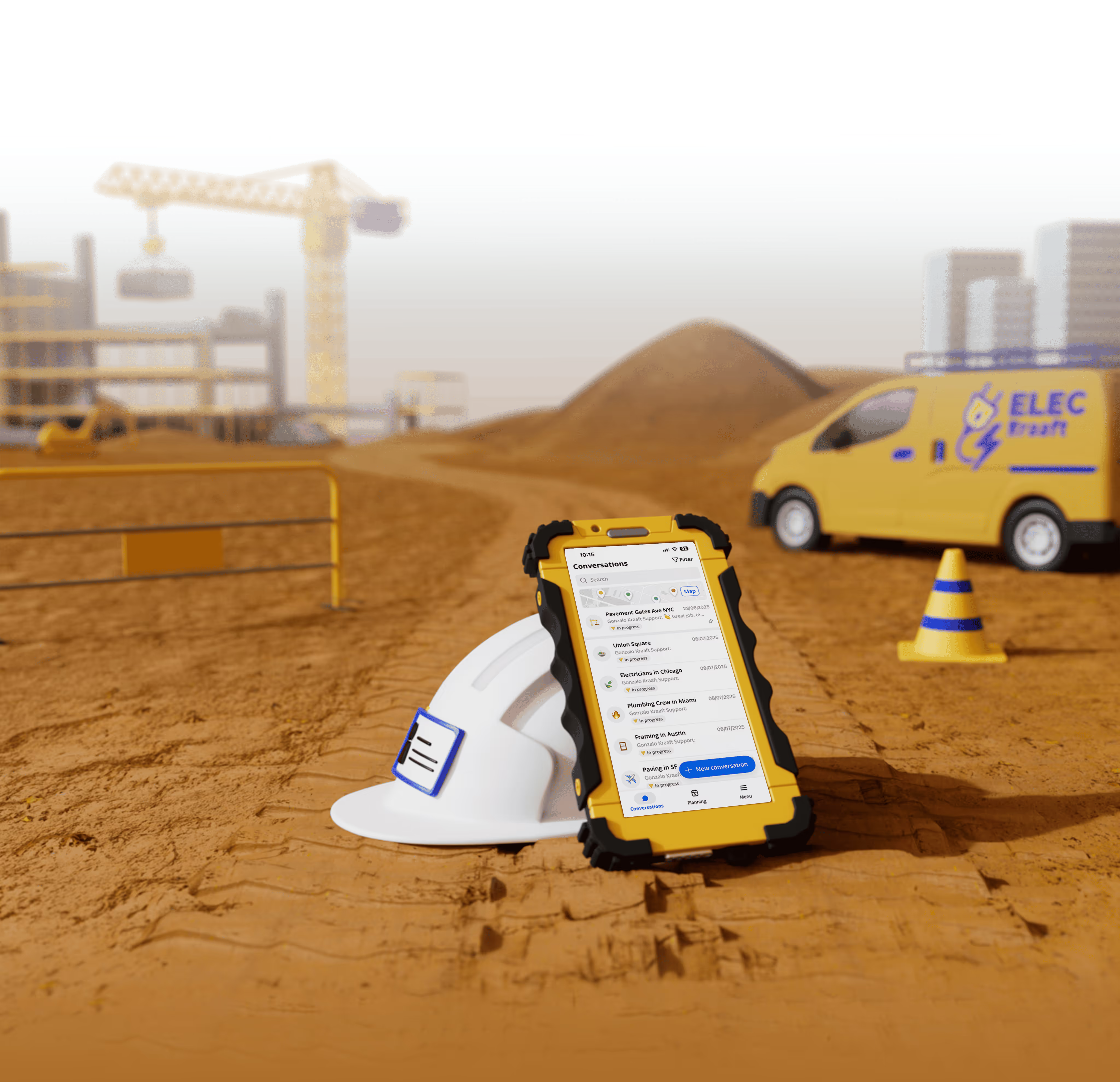
This is where digital tools give HSE teams a meaningful advantage. Paper-based reporting introduced after the fact — often from memory, back at the office — is unreliable. Kraaft's mobile reporting feature lets the person who discovers the issue capture photos and fill in a structured form directly on site, producing dramatically better data — with GPS location automatically attached to every report.
Reviewing and Improving Your Security Posture
Construction site security isn't a one-time setup — it needs to be reviewed regularly as the project evolves. Access routes change as the build progresses. New subcontractors arrive. High-value deliveries create temporary vulnerabilities. A security walk-through at key project milestones, and after any incident, is good practice.
Track your incidents over time. If you're seeing repeat theft from the same zone, or repeated unauthorized access at the same entry point, the data will tell you where to focus your effort. An incident log that's actively reviewed turns security from a reactive function into a proactive one.
Involve your site teams. Workers are often the first to notice suspicious activity, unfamiliar vehicles, or equipment that's been tampered with. A culture where reporting is easy and encouraged — not bureaucratic and burdensome — is one of the most effective security assets you can build. See how Kraaft makes field reporting simple.
Key Takeaways for HSE Teams
Construction site security is a structured discipline, not an afterthought. HSE professionals who treat it with the same rigor as fire safety or PPE compliance will reduce losses, lower liability exposure, and create safer sites for everyone on them. The fundamentals — perimeter control, access management, lighting, surveillance, and thorough incident reporting — apply to sites of every size and type.
The difference between a site that repeatedly suffers theft and incidents and one that doesn't usually isn't budget: it's process.
Want to streamline security incident reporting on your sites? Kraaft lets your teams report incidents directly from the field — with photos, GPS location, and structured forms — so nothing gets lost between site and office. Start for free or book a demo.

Reconnect the site
and the office