



The Construction Labor Shortage Is Here to Stay — Here's How Smart Contractors Are Adapting

The Construction Labor Shortage Is Here to Stay — Here's How Smart Contractors Are Adapting
The construction industry needs half a million more workers. Right now.
According to the Associated Builders and Contractors, the US construction sector faces a shortage of over 500,000 workers — and that number is projected to grow as infrastructure spending accelerates and baby boomers continue to exit the workforce. Meanwhile, fewer young people are choosing the trades, and competing industries are aggressively recruiting the same labor pool.
You already know this. The question isn't whether there's a construction workforce shortage — it's what you're going to do about it.
Some contractors are adapting better than others. Not because they've cracked some secret hiring formula, but because they've fundamentally changed how they operate. Here's what they're doing differently.
Why the Trades Aren't Drawing New Workers
Let's be honest about the root causes before talking solutions.
Construction has an image problem. Despite paying competitive wages — often far above what a four-year-degree job pays at entry level — the industry still struggles to attract younger workers. Long hours, physical demands, and the perception that "construction is old-fashioned" keep a lot of potential talent away.
And here's the part that's actually fixable: when a new hire shows up and finds a crew running on paper logs, a WhatsApp group with 50 unread messages, and verbal instructions passed down a chain of people... it reinforces exactly that image. You're not just competing on wages. You're competing on the work experience itself.
What High-Performing Contractors Are Doing Differently
1. Getting more out of the team they already have
The fastest way to deal with a construction labor shortage isn't to hire more people — it's to stop losing productivity to avoidable waste.
Think about how much time your field crew spends on things that have nothing to do with building: hunting down the right set of plans, waiting on instructions, filling out paper reports at the end of a long day, taking calls from the office asking "where are you with that?" A conservative estimate puts administrative and communication overhead at 30–40 minutes per worker per day on a poorly organized site.
On a 10-person crew, that's the equivalent of a full-time employee doing nothing but paperwork and phone tag. Contractors who've streamlined field communication and reporting are effectively getting more output without adding headcount.
2. Reducing turnover (which is expensive and underestimated)
Replacing a skilled tradesperson costs real money — recruiting fees or time, onboarding friction, productivity loss while the new person gets up to speed. Estimates range from $5,000 to $15,000+ per departure depending on the role and specialization.
The contractors with the lowest turnover aren't always the highest-paying ones. They're often the ones where people feel organized, respected, and well-informed. A field worker who ends their day knowing exactly what got done, what's expected tomorrow, and that their work is being tracked and appreciated — that person is more likely to show up next Monday.
3. Capturing institutional knowledge before it walks out the door
When your best superintendent retires, he takes decades of job-site judgment with him. Every workaround, every supplier relationship, every "we tried that on the Riverside job and here's why it failed" — gone.
The smarter companies are building systems to preserve that knowledge: standardized report templates, documented site procedures, photo logs with geo-tags, project histories that live in a central place instead of someone's memory. It's not a replacement for experience, but it means the next generation doesn't have to start from zero.
4. Making new hires productive faster
The traditional construction onboarding is "shadow Mike for a week." Not a bad approach when Mike has time — but in a labor-short environment, Mike is already stretched thin.
Contractors who've invested in accessible, mobile-friendly systems for their field crews find that new hires get up to speed faster. Plans are on the app. Past site photos are searchable. The right contact is one tap away. You don't need to memorize everything on day one — you just need to know where to find it.
Construction Field Management Software: Built for the Field, Not the Office
There's a fair amount of skepticism about construction tech. And honestly, some of it is warranted — the industry has seen too many expensive construction site management software deployments that field crews never actually used.
The difference between tools that stick and tools that don't usually comes down to this: was it built for the office, or for the field?
A foreman managing three crews isn't going to open a 15-tab dashboard on a construction management platform. But he will send a voice note and a geotagged photo in 20 seconds from the cab of his truck. That's the bar. If the construction crew management app works like that, crews adopt it. If it doesn't, it becomes shelfware.
The companies seeing real results from technology adoption picked tools that looked and felt like apps their teams already used — messaging apps, not enterprise software. Low training burden, high daily utility.
A Real-World Example
Consider a mid-size electrical subcontractor running 20 field technicians across multiple job sites. They were managing everything via text message and phone calls. Information fell through the cracks constantly, site reports were incomplete or late, and project managers spent the first two hours of every morning just trying to understand what had happened the day before.
After switching to a construction app built for subcontractors, the change wasn't dramatic on any individual job. But across the portfolio, over a full year: fewer mistakes, fewer return trips, fewer client complaints. And critically — field techs started telling their friends the company was "organized." In a tight labor market, word of mouth from your own crew is your best recruiting tool.
Don't Sleep on the Employer Brand Angle
Technology adoption isn't just an operational play — it's a recruiting signal.
When a job candidate walks into an interview and learns that your company uses modern tools, that crews communicate through a dedicated construction communication app instead of chaotic group texts, that reports are digital and plans are always accessible... that matters to a certain type of hire. Especially younger workers who've grown up expecting their employer to have their act together digitally.
It won't replace a competitive pay package or a strong safety culture. But in a market where candidates have options, the perception that your company is well-run is an edge.
The Bottom Line
The construction labor shortage isn't a short-term disruption — it's a structural shift. Companies that wait for the market to normalize are going to be waiting a long time.
The ones pulling ahead are:
- Maximizing productivity by eliminating communication and reporting overhead
- Retaining their people by creating a more organized, less frustrating work environment
- Preserving expertise before it walks out the door at retirement
- Accelerating onboarding so new hires contribute faster
- Building an employer brand that makes recruiting a little easier
None of this requires a massive technology overhaul. It often starts with one simple change: giving your field crews a better way to communicate and document their work.
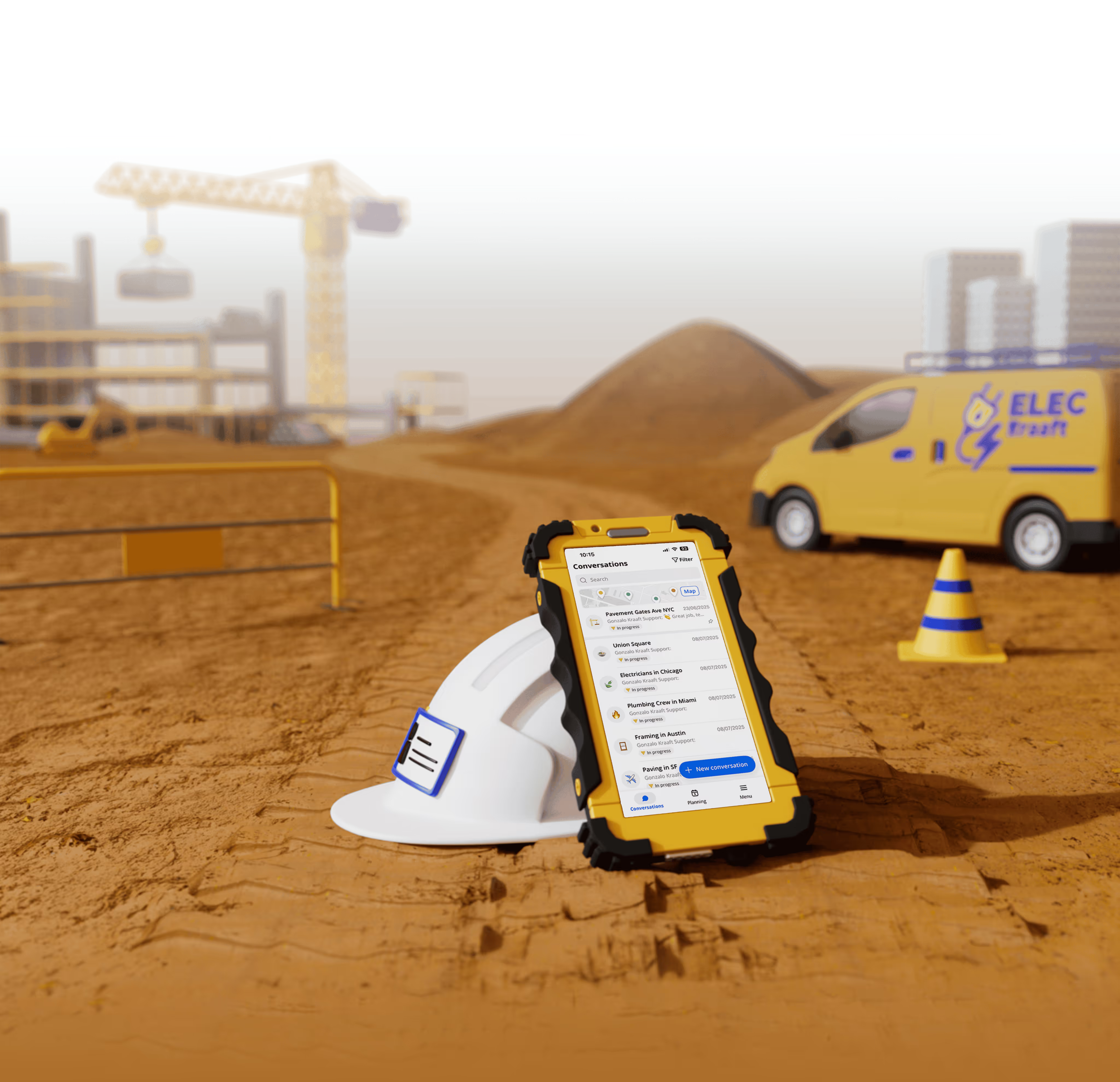
Kraaft is the all-in-one field reporting software built for construction crews — chat, reports, site maps, and project files, all in one place. Start free →

Reconnect the site
and the office